



Schema-focused therapy, also called schema therapy, is a form of psychotherapy that looks at long-standing patterns in how you think, feel and relate to people, and helps you understand where they came from and practise new ways of responding. It was developed by psychologist Jeffrey Young, blends cognitive behavioural therapy (CBT) with experiential and relationship-based work, and is usually longer-term than a short skills course. Below, we explain how it works, what a session can look like, what the research does and doesn’t show, and how to decide whether it might suit you.
What is schema-focused therapy?
In this approach, a “schema” is a lasting pattern of beliefs, emotions, memories and expectations about yourself and other people. Many schemas form early in life, in response to what we needed and what we got. Some are helpful. Others become unhelpful habits that keep showing up in adulthood, even when you can see them and want to change.
Schema-focused therapy helps you notice those patterns, understand what set them off, and build steadier ways of coping. It is not about blaming your family or going back over the past for its own sake. The past matters here because it explains why a pattern feels so convincing in the present.

What are schemas?
Young’s model describes 18 early maladaptive schemas, grouped into broader themes such as connection, autonomy, and self-worth. You don’t need to memorize them. In practice, they tend to sound like familiar inner rules:
- “People I care about will eventually leave.”
- “I’m not good enough unless I get everything right.”
- “It isn’t safe to rely on anyone.”
- “My needs come last.”
If one of these sounds oddly familiar, that doesn’t mean you have a problem to be fixed, and reading a list online can’t tell you which schemas apply to you. A trained clinician works that out with you over time.
What are schema modes?
Modes are the “states” you can slip into when a schema gets triggered. Schema therapy often describes a vulnerable or hurt part of you, a coping part that tries to protect you (by avoiding, pleasing, or overcompensating), a harsh inner critic, and a healthy adult part that can respond with care and perspective. A lot of the work is helping that last part get stronger.
How is schema-focused therapy different from CBT?
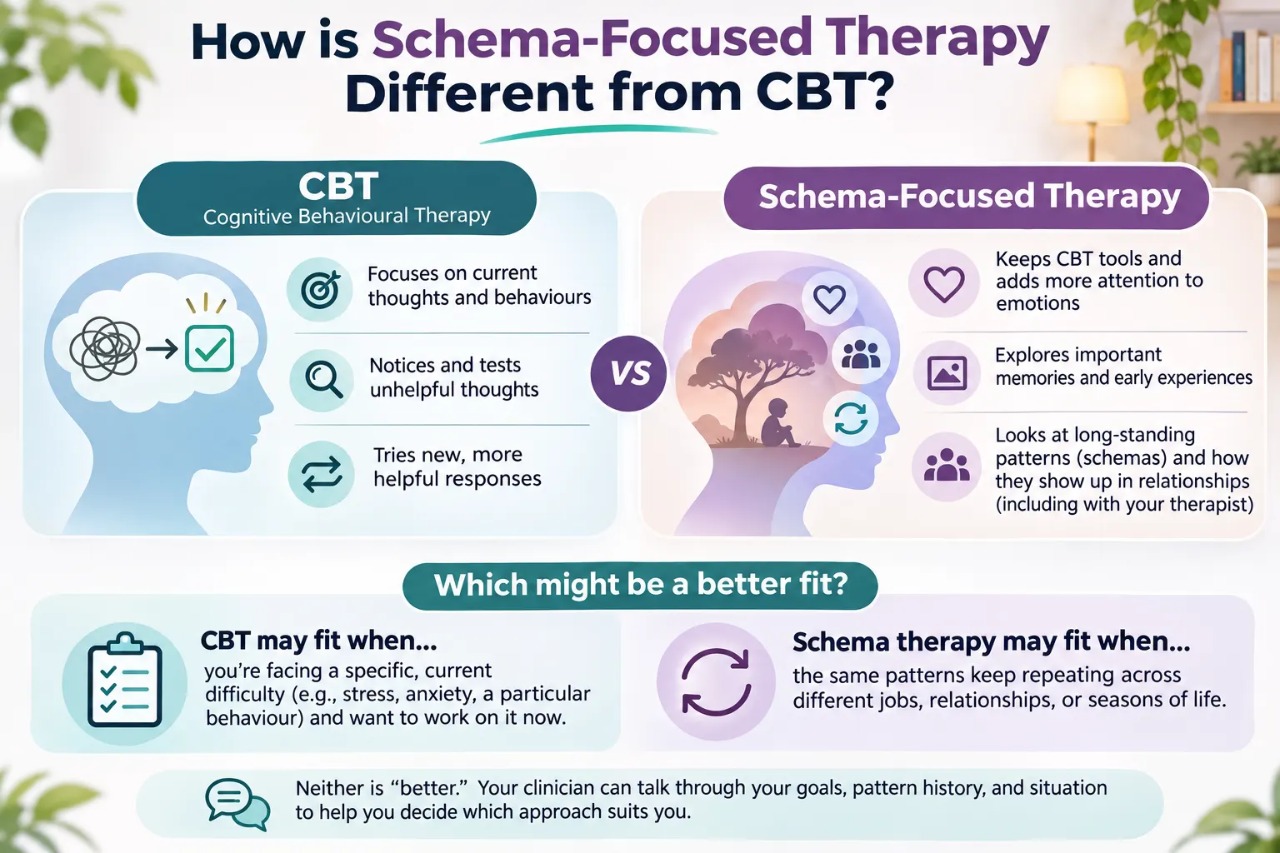
CBT usually works on current thoughts and behaviours: spotting an unhelpful thought, testing it, and trying something different. Schema therapy keeps those tools but adds more attention to emotions, memories, and the way patterns play out in relationships, including the relationship with your therapist.
Neither is “better.” CBT is often a good fit for a specific, current difficulty. Schema therapy is more often considered when the same patterns keep repeating across different jobs, relationships, or seasons of life. Your clinician can talk through which fits your situation.
What can schema-focused therapy help with, and what does the research say?
Schema therapy was first developed for people with long-standing, hard-to-shift difficulties, and the strongest research is in borderline personality disorder (BPD). In a randomized trial published in 2006, schema-focused therapy was compared with transference-focused psychotherapy in 88 people with BPD, and over three years more people in the schema therapy group recovered. A larger 2022 trial across five countries, with 495 adults with BPD, found that individual plus group schema therapy was more effective than optimal treatment as usual.
Outside of BPD, the picture is less settled. Cleveland Clinic describes schema therapy as newer and less studied than CBT, with research continuing into its use for conditions such as eating disorders, depression and panic. So we don’t tell anyone it will work for their situation. A clinician needs to complete an assessment first, and not every concern is a good match for this approach.
What happens in a schema therapy session?
Every clinician works a little differently, but schema-focused therapy usually moves through a few stages:
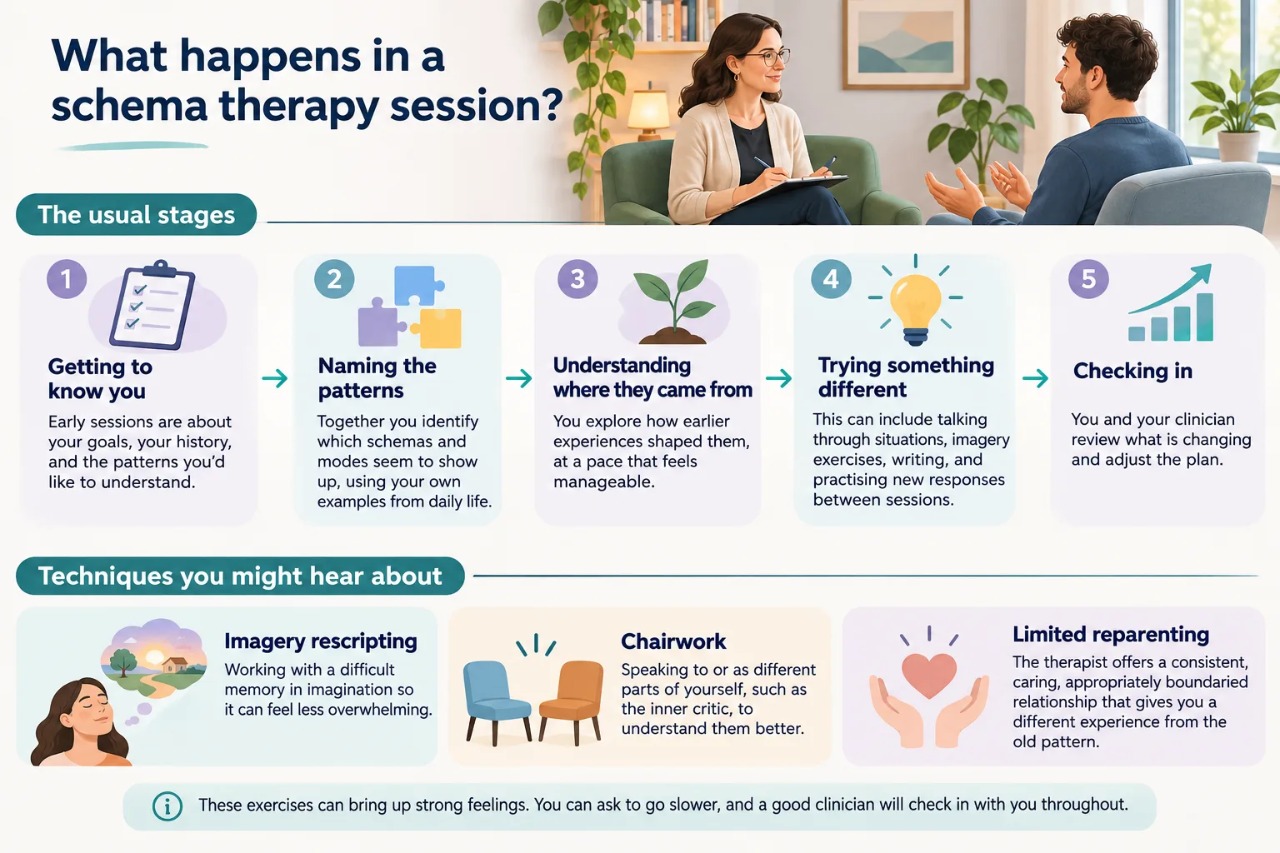
- Getting to know you. Early sessions are about your goals, your history, and the patterns you’d like to understand.
- Naming the patterns. Together you identify which schemas and modes seem to show up, using your own examples from daily life.
- Understanding where they came from. You explore how earlier experiences shaped them, at a pace that feels manageable.
- Trying something different. This can include talking through situations, imagery exercises, writing, and practising new responses between sessions.
- Checking in. You and your clinician review what is changing and adjust the plan.
Techniques you might hear about
- Imagery rescripting: working with a difficult memory in imagination so it can feel less overwhelming.
- Chairwork: speaking to or as different parts of yourself, such as the inner critic, to understand them better.
- Limited reparenting: the therapist offers a consistent, caring, appropriately boundaried relationship that gives you a different experience from the old pattern.
These exercises can bring up strong feelings. You can ask to go slower, and a good clinician will check in with you throughout.
How long does schema-focused therapy take?
It is often longer-term, and there is no single timeline. Research on BPD describes treatment lasting a year or more. For other concerns, the length depends on your goals, what you’re working on, and how often you meet. Be wary of anyone who promises a set number of sessions for lasting change before they have met you.
Is schema-focused therapy right for you?
It may be worth asking about if you notice the same emotional or relationship patterns repeating, even after you’ve tried to change them: ongoing self-criticism, difficulty setting boundaries, people-pleasing, avoidance, or reactions that feel bigger than the situation. It may be less suitable if you want a short, practical skills-based approach for one specific issue, or if you’re in the middle of an acute crisis and need stabilizing support first.
Questions worth asking any therapist before you start
- What training do you have in schema therapy?
- How would you decide whether this approach fits what I’m dealing with?
- What would the first few sessions involve?
- How would we know if it isn’t helping, and what would we do then?
Check who you’re seeing
In Ontario, only members of the College of Registered Psychotherapists of Ontario (CRPO) can call themselves Registered Psychotherapists. Other clinicians use the titles of their own regulatory colleges, such as the Ontario College of Social Workers and Social Service Workers. You can look up any clinician on their college’s public register.
Frequently Asked Questions
Is schema-focused therapy the same as schema therapy?
Yes. The names are used interchangeably. You may also see it spelled “schema-focussed therapy.”
Is schema therapy evidence-based?
There is good research for borderline personality disorder, and research is growing for other concerns. The evidence is less established for some of the things people hope to use it for, so it’s fair to ask your clinician what supports its use for your situation.
Can I do schema therapy online?
Many people do. At InnerLinks we offer in-person sessions in Peel Region and virtual sessions across Ontario.
Will I have to talk about my childhood?
Early experiences usually come up because they help explain current patterns, but you set the pace. You don’t need to share anything before you’re ready.
Is it only for personality disorders?
It was developed for them and has the most research there, but clinicians also use it to help people understand repeating emotional and relationship patterns. Whether it fits you is something to decide with a clinician after an assessment.
How much does it cost?
Our fees are on our Fees page.
When to get help right away
This article is general information. It is not therapy, a diagnosis, or an emergency service. If you are thinking about suicide or are in crisis, call or text 9-8-8 (Suicide Crisis Helpline) any time, anywhere in Canada. If someone is in immediate danger, call 911.
Talk with us about whether schema therapy fits
If this sounds like something you’d like to explore, you can book a free 15-minute consultation. It’s a chance to ask questions and learn about our services. It does not replace a clinical assessment. You can also read about schema therapy at InnerLinks or meet our clinicians.